Contents
This documentation is intended for people trained to be DAQ operators.
It describes the Virgo DAQ architecture and the DAQ software components.
This document can be found on the web (lappweb06.in2p3.fr/virgo/daqManual/daqComponents.html).
An other document, the "DAQ Operation Manual" is available in DAQ room,
in the yellow folder
called "Interferometer Procedures", and on the web (http://lappweb06.in2p3.fr/virgo/daqManual).
List of acronyms can be found at the end of the document.
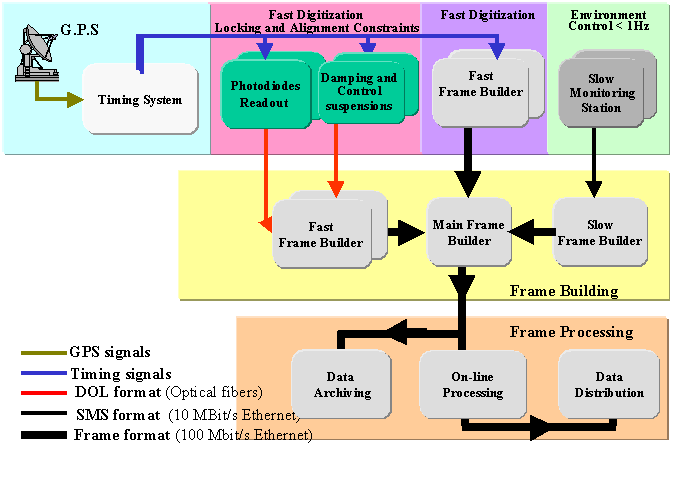
The Data Acquisition is part of the VIRGO Online System shown below.
It uses synchronization signals and time stamps delivered by the Timing system.
A set of Slow Monitoring Stations (SMS) delivers environment control
data sampled
at a low rate (<1 Hz). Those slow monitoring informations are passed
to a dedicated
part of the DAQ system: the Slow Frame Builder, which formats them
into frames.
The locking, alignment and suspensions control systems include various
servo loops and
deliver both detector and auxiliary information sampled at much higher
rate.
Those data are collected by readouts units and passed through Digital
Optical links (DOL)
to Fast Frame Builders, which formats them into frames.
Any other available data sampled at high rates (up to 20 kHz) are collected
and structured
into frames by fast Frame builders.
The Main Frame Builder is used to combine frames received from the various frame builders.
The Data Collection is assumed by 3 DAQ lines running independently
with their own
Main Frame Builder (local Main Frame Builder). Each local Main Frame
Builder
sends frames to a central Main Frame Builder (FbmMain) which outputs
frames
to raw data archiving and online processing tasks.
The 3 DAQ line are the following:
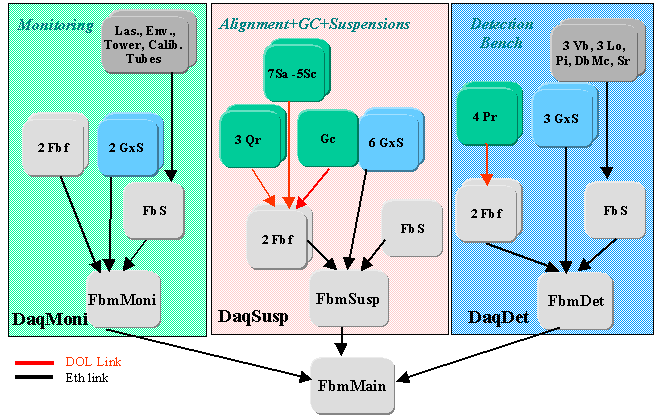
The Detection Bench DAQ line is
in charge of collecting all the data coming out from the
detection bench (camera readout, photodiode readout or Slow Monitoring
Stations
dedicated to detection bench).
The table below shows all the servers currently seen by the DaqDet
line:
Server CPU Crate Comments
Front-end servers:
Pr27 rio27a C27 EB - D1,D1p photodiodes readout - 27 channels
Pr28 LAPP EB - D1,D1p photodiodes readout - 27 channels
Pr29 rio29a C29 IB,EB - D2,D2p,D5 photodiodes readout - 15 channels
Pr70 rio70a C70 NE - D7 photodiodes readout
Pr80 rio80a C80 WE - D8 photodiodes readout
Pi25 rio25a C25 Picomotors control on Output Bench
Mc25 rio25a C25 Output Mode Cleaner Control
Fast Frame Builders:
Fbf16a rio16a C16 Data from Pr27, Pr28
Slow Frame Builder:
FbsDet alpha fbl3 Data from Vb25, Sr25, Lo25
Main Frame Builder:
FbmDet alpha fbl3 Data from Fbf16a, FbsDet, Pi25, Mc25
FbmDetCsm1 alpha fbl3 Consumer (send frames to FbmMain)
FbmDetShift alpha fbl3 Consumer (send frames to operator on shift)
FbmDetUsers alpha fbl3 Consumer (send frames to any online user)
The Suspensions, Alignment and Global Control DAQ Line is in charge
of collecting all
the data coming out the various Suspensions and interferometer alignment
and control systems.
The table below shows all the servers currently seen by the DaqSusp
line:
Server CPU Crate Comments
Front-end servers:
GxSrio40B:IB rio40b C40 Input Bench Suspension Gx Server (camera readout)
GxSrio42B:IB rio42b C42 Power Recycling Suspension Gx Server
GxSrio44B:IB rio44b C44 Beam Splitter Suspension Gx Server
GxSrio46B:IB rio46b C46 West Input Suspension Gx Server
GxSrio48B:IB rio48b C48 North Input Suspension Gx Server
GxSrio50B:IB rio50b C50 Output Bench Suspension Gx Server
GxSrio25B:IB rio25b C25 End Bench Gx Server
GxSrio72B:IB rio72b C72 North end Bench Gx Server
GxSrio82B:IB rio82b C82 West end Bench Gx Server
Fast Frame Builders:
Fbf17a rio17a C17 Data from suspensions IB, PR, BS, WI, NI, OB
Slow Frame Builder:
FbsSusp alpha fbl2 Data from Suspensions LVDT, towers temperatures
Main Frame Builder:
FbmSusp alpha fbl2 Data from Fbf17a, Gx's, FbsSusp
FbmSuspCsm1 alpha fbl2 Consumer (send frames to FbmMain)
FbmSuspShift alpha fbl2 Consumer (send frames to operator on shift)
FbmSuspUsers alpha fbl2 Consumer (send frames to any online user)
The Monitoring DAQ line is in charge of taking environment data from
various
monitoring tasks (microphones, accelerometers, EM probes, signals from
IB/Laser/MC)
in the Central Building and in the Mode Cleaner Building
The table below shows all the servers currently seen by the DaqMoni
line:
Server CPU Crate Comments
Fast Frame Builders:
Fbf39 rio39a C17 Central Building environment monitoring, IB/Laser/MC signals
Fbf61 rio61a C14 MC building environment monitoring
Slow Frame Builder:
FbsMoni alpha fbl1 Data from vacuum, LaDiode(laser), building temperatures
Main Frame Builder:
FbmMoni alpha fbl1 Data from Fbf39, Fbf61, FbsMoni
FbmMoniCsm1 alpha fbl1 Consumer (send frames to FbmMain)
FbmMoniShift alpha fbl1 Consumer (send frames to operator on shift)
FbmMoniUsers alpha fbl1 Consumer (send frames to any online user)
DaqMain is the main stage of the Data Acquisition system. It controls
the central Main Frame Builder
(FbmMain) and the Master Timing Server which is necessary to run the
overall system.
The table below shows all the servers currently seen by DaqMain:
Server CPU Crate Comments
Master Timing:
TiServer rio11a C11 Master Timing Server (providing GPS time and run#)
(seen in fact by FbmSusp, FbmDet and FbmMoni)
Sources of Frames:
FbmDetCsm1 alpha fbl3 Consumer (send frames to FbmMain)
FbmSuspCsm1 alpha fbl2 Consumer (send frames to FbmMain)
FbmMoniCsm1 alpha fbl1 Consumer (send frames to FbmMain)
Main Frame Builder:
FbmMain alpha fbm Data from FbmDetCsm1, FbmSuspCsm1, FbmMoniCsm1
FbmMainCsm1 alpha fbm Consumer (send frames to fdwrite_proc)
FbmMainShift alpha fbm Consumer (send frames to operator on shift)
FbmMainUsers alpha fbm Consumer (send frames to any online user)
FbmMainWrite alpha fbm Consumer (send frames to non permanent data storage (scratch disk of ax9))
FbmMainDisk alpha fbm Consumer (send frames to large data storage)
FbmMainTrend alpha fbm Consumer (send frames to Trend Frame Builder)
FbmMainTrend50 alpha fbm Consumer (send frames to 50Hz Trend Frame Builder)
FbmMainOP alpha fbm Consumer (send frames to first Online Processing task)
They all run on RIO806X CPUs under LynxOS real-time system. Configuration
files are
currently stored in /virgoData/Fbf-Pr-GxS-TiM and will be stored in
the data base Db
in normal running conditions.
Master Timing Server : TiM
It manages the basic properties of the timing signals used over the Virgo online systems.
It is made of 2 parts:- The generator & distributor part uses a fast clock provided by GPS board (5 MHz).
It generates and distributes the 4 hardwired signals (fast clock, sampling, frame, run)
and reads each frame's starting time (GPS time).- The monitor & control part checks the sampling signal propagation and measures the
round trip time along the distribution system.
Photodiodes Readout : Pr & QrHardware components : 1 CPU, 1 Timing board, 1 GPS board, 4 TTL/OPT boards, + 8 OPT/TTL boards, 5 Timing boards, 1 GPS board Delivered signals : Fast clock: 2.5 MHz (if GPS used) 2 MHz (if no GPS), Sampling: 20KHz, Frame: 1Hz Software description : starts the main Timing board, reads GPS board, sends timing information to servers, sends GPS time and run number to slow frame builders and main frame builders.
Hardware components :
(1) ADC read: 1 CPU, 1 Timing board, ETEP298A
ADC boards (up to 96 ADC's channels)
(2) DOL read: 1 CPU, n DOL boards.
Hardware components : 1 CPU, 1 Timing board, up to 5 Camera boards Running conditions : Used also within suspension's crate. Camera IRQ frequency: 50Hz Software description : -Front end server and User's timing -Used for Camera readout (alignment or local controls) -Write timing information in suspensions DSP memory through VME bus. -Calculate position using fine, coarse or telemeter algorithm. - Send calculated positions to DSP through VME bus - Build and send frames
They all run on Alpha XP1000 workstations under OSF1 v5.0 Unix operating
system.
Configuration files are currently stored in /virgoData/Fbs-Fbm and
will be stored
in the data base Db in normal running conditions.
Main Frame Builder : Fbm and FdCsm
- Producer: merge frames coming from fast frame
builders and slow frame
builders and put them in a shared memory. Only one producer
manages one shared memory. It receives also frame's header
informations (GPS time, run number, etc...) from the Master Timing.
(/virgoApp/Fbm/vXrY/OSF1/Fbm)
- Consumer: read frames in shared memory and
send them on Ethernet network.
Several consumers can read the same shared memory.
(/virgoApp/Fd/vXrY/OSF1/FdCsm)
Slow Frame Builder : Fbs
The Data Acquisition System requires the following software packages:
Basic packages:
/virgoApp/Fr Frame Library
/virgoApp/Cfg Config parser and more...
/virgoApp/CSet
/virgoApp/Cm Multipurpose Communication Machine (use CSet)
/virgoDev/Fd Frame distribution library and utilities (use CSet, Cm, Cfg, Db, El, Su)
/virgoDev/Vx VME interface fot LynXOS real time
/virgoApp/Ti Timing Library (use Vx)
/virgoApp/Do Digital Optical Link Library
/virgoApp/Adc298 Adc298 (16 channels) libraryServers:
/virgoApp/TiM Master Timing (use Vx, Ti, Cfg, CSet, Cm, Fr, Fd, Db, El, Su)
/virgoDev/GxS Camera readout (use Vx, Ti, TiM, Cfg, CSet, Cm, Fr, Fd, Db, El, Su)
/virgoDev/Pr Photodiodes Readout (use Vx, Ti, TiM, Do, Cfg, Fbf, Fd)
/virgoDev/Fbf Fast Frame Builder (use Vx, Ti, TiM, Do, Cfg, CSet, Cm, Fr, Fd, Db, El, Su, Adc298)
/virgoDev/Fbs Slow Frame Builder (use Cfg, Fr, Fd, CSet, Cm, Db)
/virgoDev/Fbm Main Frame Builder (use Cfg, Fr, Fd, CSet, Cm, Db, El, Su)